
What if nothing is wrong?
What if the things we experience don’t always need to be changed?
What if they first need to be fully met?
Imagine sharing something vulnerable with someone you love. You tell them what is alive inside you. Something hurts. Something feels uncertain. Something doesn’t feel quite right. Maybe you don’t even know exactly what you need yourself. Maybe you’re not looking for an answer at all. Maybe you simply want to be able to say it out loud. To make some space for what is alive inside you, without it immediately needing to go anywhere.
And then the solutions come.
You could try this.
Maybe you should look at it this way.
Why don’t you try…?
Have you ever thought about…?
Often, it comes from love. From the desire to help. To make things lighter. To do something for the other person. We see someone we love struggling, and somewhere inside us, a movement immediately arises: how can I make this better for you?
And yet, after a conversation like that, an undefined feeling can remain.
As if you were heard, but not completely seen.
As if what was alive inside you had almost unnoticedly turned into a problem that needed to be solved.
Maybe this touches on something deeply human.
We have a strong tendency not to let discomfort exist for too long. As soon as something hurts, we look for a way out. As soon as something feels uncertain, we want to know what comes next. As soon as something feels difficult, we want to understand how we can change it. And as soon as someone we love is suffering, we want to do something that will make the suffering less.
We fix.
And not only for each other.
We do it to ourselves, too.
When sadness arises, we try to feel better. When we feel uncertain, we look for reassurance. When we are angry, we try to understand where the anger comes from or how to get rid of it. When we are afraid, we want to know that everything will be okay.
We make plans. We analyze. We look for insights. We meditate. We breathe. We read. We talk. We search for ways to help ourselves.
And there is nothing wrong with that in itself.
But even our most loving attempts at personal growth can sometimes become a subtle form of resistance to what is actually here.
As if the present moment is not quite allowed to exist as it is.
As if sadness only has value when it leads somewhere. As if fear needs to be resolved before we can move on. As if pain is a mistake that needs to be corrected as quickly as possible.
But what happens when we stop trying to fix it?
When we simply sit with what is?
Not from the question:
How do I get rid of this?
But:
What is actually here?
Can you stay long enough to truly feel it?
Can you let it exist without immediately asking it to change?
Can you meet what is here without immediately trying to understand it, solve it, or let it go?
Maybe that is where something essential begins.
Because truly being present is something different from fixing.
It doesn’t say: I know how you can get out of this.
It says:
I am here.
I see that this is here.
You don’t have to be anywhere other than here right now.
And maybe that is a form of love that goes beyond comforting.
The kind of love that says:
I don’t have to take your pain away in order to stay with you.
What if that is one of the most essential forms of being seen? Not that someone gives us a way out, but that someone stays with us while we ourselves still don’t know which way to go.
That someone doesn’t try to take the discomfort away for us, but keeps us company while we are right in the middle of it.
And this is where listening takes on a much deeper meaning.
Listening is not waiting for your turn to speak. Nor is it listening while, in the meantime, your mind is already searching for the right answer, the best solution, or something you can say that will make the other person feel better.
Truly listening is being present without an agenda.
It means not only hearing what someone says, but also noticing the pace at which something is being told. The silences. The hesitation. The uncertainty. The emotion that perhaps does not yet have words.
It means not giving meaning too quickly to what someone shares with you.
Not immediately filling in the blanks.
Not immediately interpreting.
Not immediately telling them what you think it means.
But leaving room for the possibility that something may simply be allowed to be for a little while longer.
And perhaps we can bring that same attitude inward.
Can we learn to meet ourselves in that way?
Not:
What do I need to do with this?
But:
Can I stay with this for a moment?
What is actually present?
Can this be here without me changing it?
That asks something of us.
It asks for courage.
To let go, for a moment, of what we are so accustomed to doing: controlling, understanding, changing.
To make space.
To listen.
To stay.
To become curious about what is truly alive within us.
And perhaps then we discover something remarkable.
That there is a difference between experiencing something and fighting the fact that we are experiencing it.
There is pain. And on top of that comes the thought that the pain shouldn’t be there.
There is uncertainty. And on top of that comes the need for certainty.
There is sadness. And on top of that comes the judgment that by now, we should be further along.
Layer by layer.
An experience becomes a problem. A problem becomes a task. And that task becomes a struggle with ourselves.
What would happen if we removed one layer?
Not by solving the pain.
But by no longer pushing it away.
Maybe loving attention is not the absence of discomfort, but the absence of the additional struggle against it.
And this is where an interesting paradox arises.
Because sometimes it is precisely when we stop trying to solve something that space arises for something to move on its own.
Not because we changed it. But because it is finally being seen.
A thought that is not fought does not need to be defeated.
An emotion that is truly allowed to be felt sometimes doesn’t need to hold on quite so tightly.
Tension can soften.
Tears can come.
Grief can unfold.
But not always.
And perhaps that is important to say.
Because presence is not a new technique for making sure we always feel better. It is not a trick through which we ultimately get to repair ourselves after all.
That would simply become another form of fixing:
If I am present for long enough, eventually this feeling will disappear.
But perhaps the deeper movement is something else.
Perhaps it is about being willing to stay, even when it doesn’t disappear.
There is a form of love in that which goes beyond comfort.
The love that says:
I don’t have to take your pain away in order to stay with you.
And perhaps we can say the same to ourselves.
I don’t have to get rid of this feeling in order to stay here with myself.
I don’t have to understand it.
I don’t have to immediately make something of it.
I don’t have to be anywhere else.
I am allowed to be here.
With whatever is here right now.
That doesn’t mean we become passive. It doesn’t mean we never change anything, make choices, or take action.
It simply means that change no longer has to begin from the belief that something is wrong with what is here now.
We can meet something before deciding what needs to happen with it.
We can feel before we act.
We can listen before we answer.
And perhaps that is exactly what yoga invites us into.
To become more intimate with what is already here.
To notice.
To feel.
To listen.
To stay.
To make space.
To become curious about the stories we carry with us, without immediately taking them to be true.
Ah.
There is that story again.
There is that belief.
There is that familiar reaction.
And instead of immediately judging it, changing it, or solving it, perhaps we can stay with it for a moment.
Just as we would stay with someone we deeply love.
Not to repair them.
Not to take away the discomfort.
But to say:
I am here.
I see you.
You don’t have to be anywhere other than here right now.
Maybe that is what self-awareness is really about. Learning to be present with what is already here. Meeting what is here.
And perhaps that is one of the most beautiful invitations of yoga.
To return.
Again and again.
To the center.
To the place within yourself from which you can observe what is happening without being completely carried away by it.
Where you can see a thought without becoming the thought.
Feel an emotion without being overwhelmed by it.
Meet uncertainty without immediately needing an answer.
Experience life without needing to control every part of it.
A quiet center.
Not separate from life.
But right in the middle of it.
This is the place.
And you can return to it.
Again.
And again.
Perhaps even in the middle of a busy day. In a conversation that touches you. In the moment you notice yourself rushing. When something doesn’t go the way you expected. When an old belief suddenly resurfaces.
You can pause. Breathe. Notice. And meet yourself again.
Even for one breath.
Even for one moment.
That is practice.
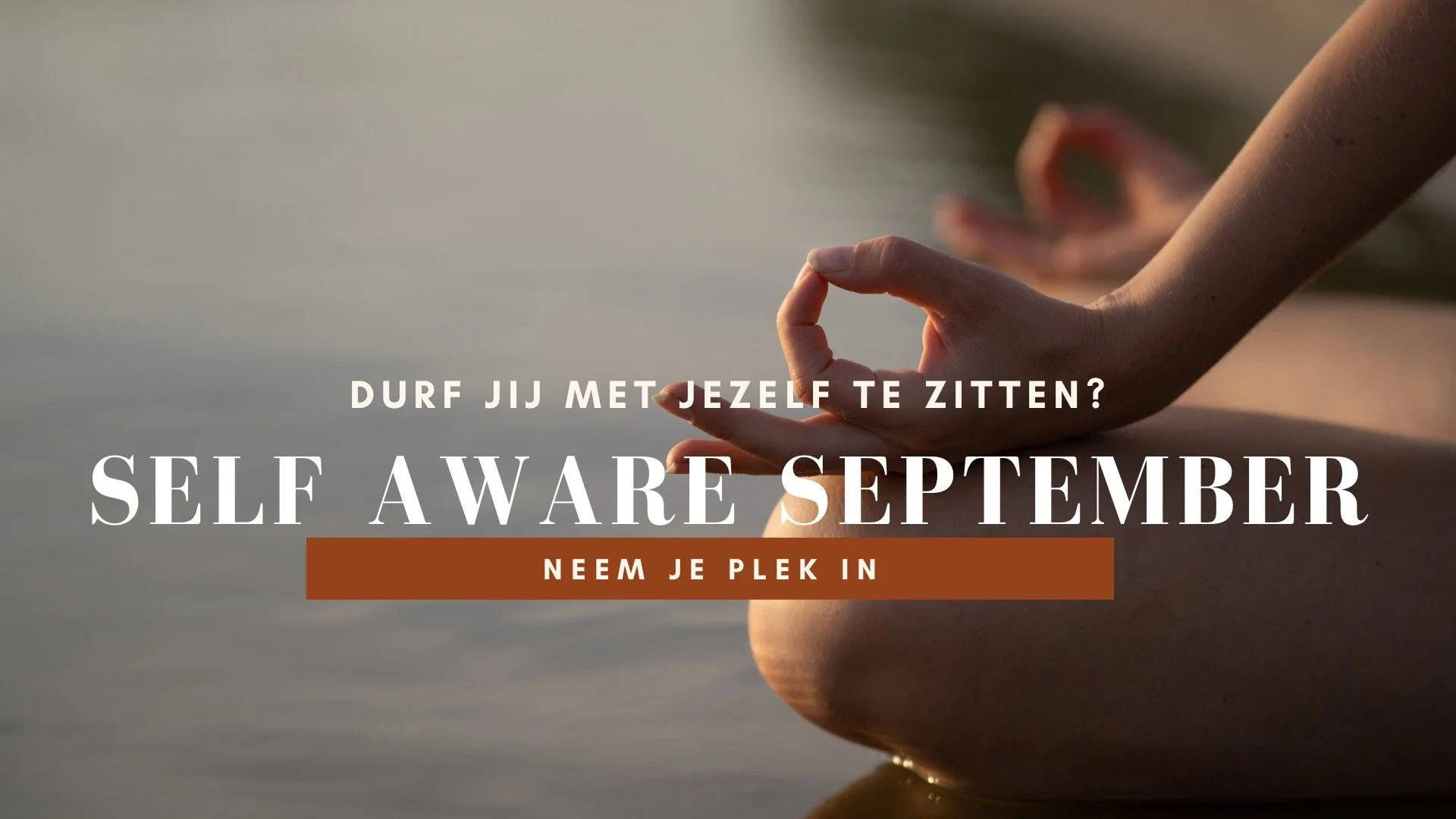
(*Dutch) Self aware september
Self Aware September is een liefdevolle uitnodiging om een maand lang, elke ochtend 5-15 minuten, plaats te nemen in de ontmoeting met jezelf. Met meditatie, pranayama, zachte beweging en zelfonderzoek. Om te vertragen, te voelen, en te luisteren naar wat er werkelijk in je leeft.
Doe jij ook mee? Durf jij het aan om met jezelf te zitten?