If Everyone Is Doing It,
I Must Too… Right?
Why We Follow the Crowd and How to Find the Courage to Trust Our Inner Direction
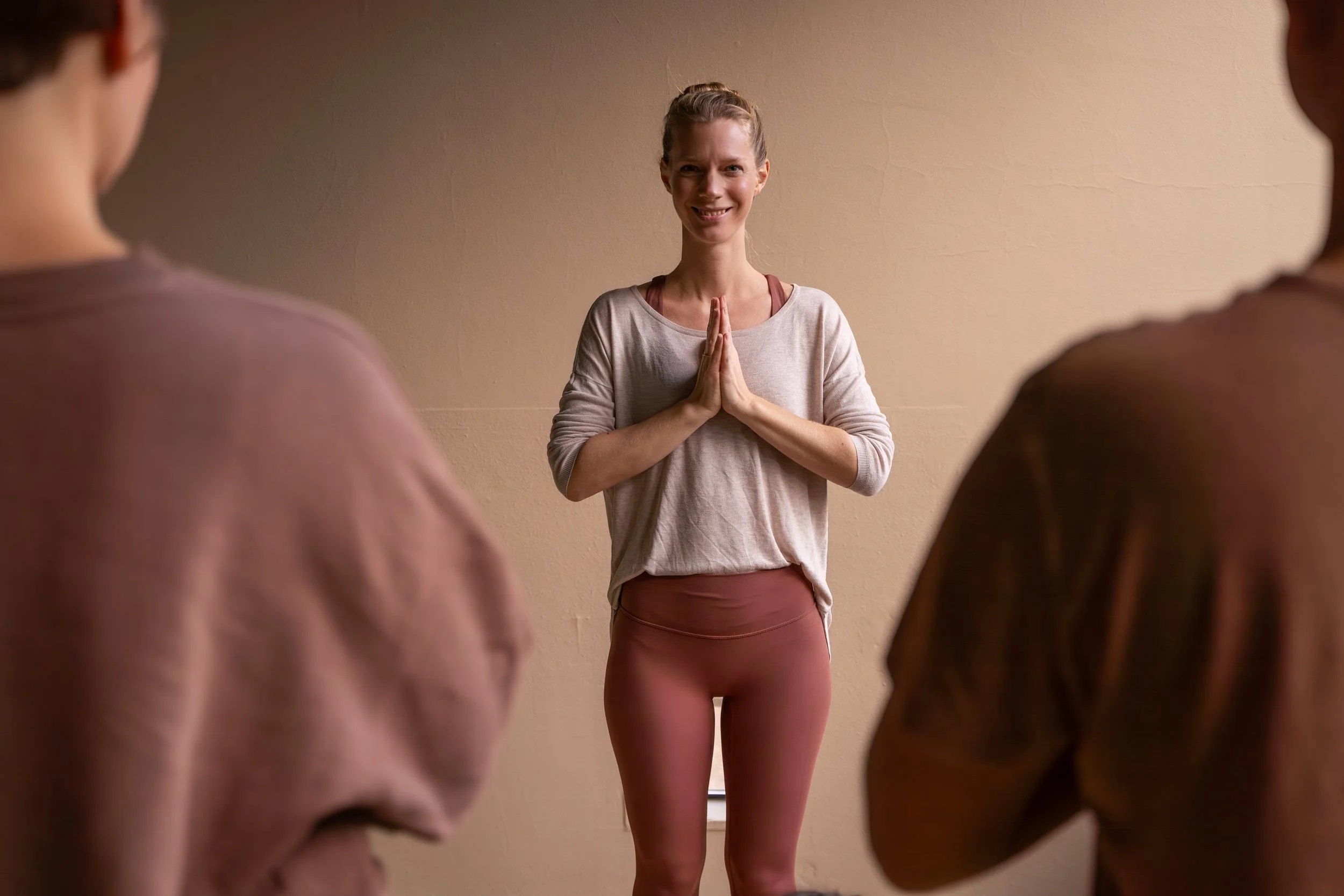
Lately in yoga classes I’ve been hearing something strikingly often, and the more frequently I hear it, the clearer it becomes that this is not just something that happens on the mat, but a reflection of how we move through life as human beings. The moment a posture is offered, you can almost see people briefly glance left and right. What is everyone else doing? How deep are they going? Can I stay behind? Am I supposed to do this too?
No matter how often a teacher gives the reminder that the practice is about meeting yourself exactly where you are, in this moment, trusting your own experience, listening inwardly, and honoring your unique process, the doubt can still remain surprisingly strong.
It is such a small movement, that quick sideways look, yet it reveals something ancient and deeply human. We orient ourselves through others. We measure safety, correctness, and belonging through what the group is doing. Not because we are incapable of sensing for ourselves, but because we are wired for connection.
Even when the teacher repeatedly gives the invite to listen inwardly, to follow the own body, to respect limits and honor ones own rhythm, something else tends to happen. The group becomes the silent norm. Not spoken, but felt. And almost unnoticed, attention shifts from inside to outside.
This doesn’t only happen in yoga rooms. You see it at the gym, where someone adds more weight simply because the person next to them does. At work, where people say yes to deadlines they know are unrealistic because “everyone else agreed.” In social settings, where we laugh at a joke that didn’t really land, just to stay aligned with the atmosphere. Even in rest: how often do we keep ourselves busy because slowing down feels like stepping out of the collective current?
What’s fascinating is that almost everyone assumes that others are doing it with ease. That the other person is stronger, more flexible, more certain. But when you speak with people afterward, you often hear the same story: doubt, comparison, adaptation. The person you saw as an example may very well have been looking at you to check whether they were “doing it right.”
We mirror each other, while all of us are mirroring at the same time.
It’s like a silent agreement forms in the room: let’s all pretend we are sure. And underneath that agreement lives something tender, the wish not to fall outside the circle.
Beneath this lies something deeply human and ancient: the need to belong to the group. Connection is a profound biological and social mechanism. Somewhere in our system lives the old memory that exclusion is unsafe. So we adapt. We soften our signals. We ignore subtle limits. Because we are conditioned to stay together.
We are, at our core, a relational species. For most of human history, survival depended on inclusion. To be separated from the tribe meant danger. Even though our modern lives rarely carry that literal threat anymore, our nervous system still reacts as if “being different” might cost us something essential. That is why going against the current, even in small ways, can feel disproportionately uncomfortable.
You can notice this in simple moments: choosing a different lifestyle than your family, eating differently at a shared table, declining alcohol when everyone else says yes, raising your child in a way that doesn’t match the dominant advice, or deciding not to rush when everyone around you is hurrying. These moments can trigger subtle inner tension, not because they are wrong, but because they are non-conforming.
But yoga, in its deeper meaning, invites something that can stand in contrast to this. Not against the group, not in rebellion, but in truth. In inner listening. In developing a refined sensitivity to what is actually happening within you, moment by moment.
The mat then becomes a laboratory of awareness.
A place where you can safely observe: What happens in me when others continue and I want to stop? What story appears when I choose differently? Do I feel behind? Visible? Exposed? Do I start negotiating with myself?
Because what really happens when you hold a posture longer than the body is asking for? When you cross a boundary because everyone else continues? When you convince yourself you can “still manage,” while your breath has already become strained? That moment is not only physical, it is existential. It is the same movement we make outside the yoga room: continuing, adapting, complying.
It is the same mechanism behind overworking, overcommitting, overgiving. Behind saying “it’s fine” when it isn’t. Behind staying longer than is healthy, in conversations, projects, relationships, habits, simply because stopping would mean stepping out of sync with what others expect or model.
Perhaps the most radical yoga practice is not how deep you go into a posture, but how honest you are in noticing your inner signals, and how courageous you are in acting on them.
Courage is often confused with pushing through, but here it takes on a different meaning: stopping where others continue. Softening where others intensify. Choosing your truth while no one is actually forcing you, except your own impulse to belong.
And often that impulse is quiet. It doesn’t shout. It whispers: Don’t be the only one. Don’t be different. Stay aligned.
Questions for self-inquiry
• When do I notice myself looking at others to determine what is “right”?
• What happens in the body the moment I move beyond my limits?
• Which subtle signals do I tend to ignore?
• What makes it feel risky to choose differently from the group?
• What belief sits underneath that, about belonging, appreciation, or safety?
Conditioning is rarely loud. It works quietly, repetitively, socially reinforced. It says: this is how we do it here. This is how it should be. This is what is normal. And the longer we move within it without examining it, the further we drift from our direct inner experience.
It shows up in trends we follow without questioning, productivity standards we adopt without reflection, wellness routines we copy without sensing whether they actually nourish us. Even “healthy habits” can become unconscious imitation when they are no longer connected to inner listening.
That is why curiosity is essential. Not judgmental, but investigative. “What is actually happening here?” This is svadhyaya in living form: the study of the self through direct experience.
Physical yoga practice then stops being a field of performance and becomes a mirror. Each posture reveals patterns: pleasing, comparing, forcing, withdrawing, controlling, avoiding. Not to condemn them, but to see them. And what is seen clearly can begin to soften.
Perhaps real freedom is not that you never look at the group again, but that you notice when you do, and gently return inward to inquire if it is also your unique choice to make in that moment.
A few more reflective questions
• Where in my life am I following movements that no longer feel true?
• In what areas do I live through automatic adaptation?
• How does it feel different when I adapt versus when I attune?
• When was the last time I respected an inner “no”?
• What changes when I use the body as a compass instead of the surroundings?
Following your own truth does not have to be loud. It does not need to be rebellious or visible. Often it is a quiet inner shift. A small choice in which you hear yourself again.
And interestingly, when one person does this sincerely, it often gives silent permission to others. Authenticity is contagious too. One grounded “no” can relax a whole room.
And paradoxically, when people truly remain with themselves, a deeper and more authentic form of connection emerges. Not based on sameness of form, but on sincerity of presence.