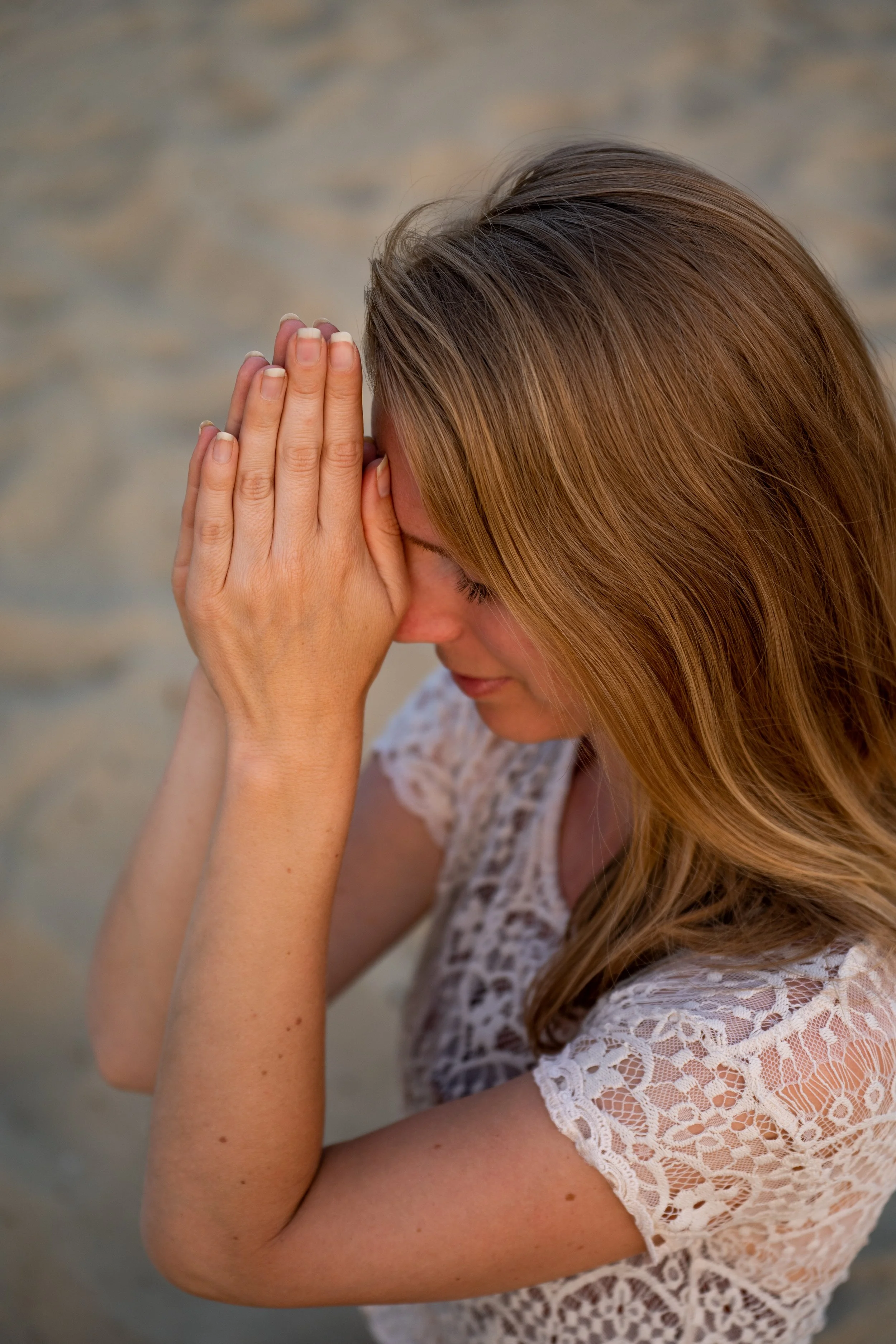
How yoga teaches us to remain free in difficult relationships
There are certain relationships in life that don’t feel “ordinary.”
Relationships that touch something in us that goes far deeper than just a disagreement, irritation, or a clash of personalities.
And interestingly enough, it is often the relationships closest to us. Family. Parents. Brothers. Sisters. People we have become so intertwined with that it can almost feel impossible to clearly see where the other ends… and where you begin.
I notice for myself that when it comes to family, I can sometimes find myself going in circles again. Maybe you recognize that too. That with friends or acquaintances, it’s much easier to feel certain boundaries or make choices, but with family, there are suddenly so many layers underneath.
Guilt. Loyalty. Responsibility. Hope. Grief. Old patterns. The inner child. And maybe also that deep longing that one day it will be different. Because family doesn’t just touch the present, it touches everything beneath it.
It touches how safe you felt growing up. Whether you were truly seen. Whether you had space to be yourself. Whether your feelings were allowed to exist. Whether your boundaries were respected. Whether love was tied to adaptation. Whether you had to take care of the other instead of the other way around.
And the complicated part is: as long as we don’t truly face these dynamics, we tend to repeat them. Sometimes literally with the same person. Sometimes in different relationships. But the essence remains the same lesson, continuing to present itself.
This is something yoga has shown me so deeply.
Not yoga as in postures on a mat. But yoga as a mirror of awareness. As a way of looking at life. At relationships. At suffering. At the patterns we keep repeating as long as they still have something in us they want to touch.
Because rarely is a meeting truly accidental.
Every relationship carries something. Every confrontation. Every rupture. Every connection.
And some relationships feel so intense because they touch something that has been with us for a very long time. As if they know exactly where our deepest wound lies. Not to break us, but to awaken something that is asking to be seen.
And that may sound beautiful or spiritual, but honestly? Sometimes it just feels incredibly painful.
Especially when someone has broken your trust more than once. When you keep finding yourself wondering:
Why do I keep ending up here? Why does this still affect me so deeply? Why can’t I just let it go?
I have faced a lot of this myself in relation to a family member.
For a long time, there was a subtle sense of guilt somewhere deep inside whenever I chose myself. As if my happiness came at someone else’s expense. As if taking up space was selfish. As if I had to make myself smaller to avoid failing the other. And for a long time, I wasn’t even fully aware of it.
Until I started to see how often I automatically adapted. How often answers were already given before I even spoke. How often I didn’t truly feel like an autonomous human being with my own voice, my own truth, my own space.
What’s interesting is that we often think freedom means that something in the situation needs to change.
That freedom means: now they finally have to understand what they’ve done. Now the past needs to be resolved. Now there has to be acknowledgment. Now the other has to change so that I can finally feel at peace.
But yoga turns that completely around.
Yoga doesn’t ask: How do I change the situation?
Yoga asks: What is happening within me? How do I relate to what is happening? What belief am I still living from? What pain is still asking for attention? What identity have I become? What story am I holding onto?
And that can be confronting. Because somewhere, we often really want the other to be “the cause” of our suffering. But what if the other is not the one causing your suffering… but the one showing you where you are still holding onto it?
That doesn’t mean everything someone does is okay. It doesn’t mean you should keep giving without boundaries. It doesn’t mean you have to trust again. And it definitely doesn’t mean you should spiritually bypass your pain.
Sometimes distance is love. Sometimes a boundary is the most compassionate thing you can do. Not only for yourself, but also for the other. Because as long as we keep moving along with old patterns out of guilt, fear, or loyalty, we often sustain exactly what drains us.
And that is not freedom.
Freedom is not accepting everything. Freedom is not abandoning yourself to keep the peace. Freedom is being able to see what is… without being completely consumed by the story around it.
To be able to say:
Yes, this hurts.
Yes, this touches something old in me.
Yes, there is grief.
But also:
I no longer have to lose myself in this.
That has become such an important distinction for me.
In the past, I would fully descend into the suffering of the other. As if I were responsible for their emotions, their pain, their behavior, their happiness. As if I had to carry it all. But in the end, I mostly lost myself in the process. And maybe you recognize that too. That you are so focused on understanding, carrying, fixing, or connecting… that you no longer feel what you actually need. That somewhere deep down, you already know: this is costing me myself.
And yet another part of you still keeps hoping for change. And that is exactly where yoga invites radical honesty.
By asking:
Where am I still abandoning myself?
What am I still trying to receive that this person may never be able to give?
That realization can be raw.
Because sometimes, as adults, we are unconsciously still waiting for something we didn’t receive as a child. Recognition. Safety. Softness. True presence. Unconditional love. And as long as we keep waiting, we often remain trapped in the same dynamic, because something in us is still asking to be seen.
In yoga philosophy, there is the word samskara. Old impressions. Patterns. Imprints that have settled into our system. Not just mentally, but energetically, emotionally, physically. And as long as those patterns remain unconscious, they live us.
We keep reacting from the same wound being pressed. From the same fear. From the same sense of lack. Until awareness arises. Until one day, in the middle of an old situation, you suddenly feel:
Wait a moment…
I don’t have to move in this the same way anymore.
That moment is so powerful.
Not because the situation immediately changes. But because you change in relation to the situation. And that is where true freedom begins. Not when life becomes perfect. Not when no one ever hurts you again. Not when everything finally feels safe. But when your inner freedom is no longer dependent on someone else’s behavior.
In yoga, this is sometimes called kaivalya, a state of inner liberation. And we often imagine that as something grand, enlightened, almost untouchable. But maybe it begins much smaller. Maybe liberation begins the moment you stop abandoning yourself.
When you no longer force yourself to cross your own boundaries. When you stop waiting for someone else to finally give you a sense of worth. When you stop constantly adapting just to preserve love.
Maybe freedom begins when you can say:
I see the pain.
I see the past.
I see the wound.
But I am not it.
I move beyond this story.
And that doesn’t mean it will never touch you again. We are human. Some relationships will always touch something within us. But space begins to emerge. A different kind of presence.
The realization that freedom is not dependent on circumstances, but has always been within you, in the way you relate to what is happening. That idea can be confronting. Because it places the responsibility fully back with you. But at the same time, something opens there. Because where it may have once felt like you were at the mercy of the dynamic, the other, the past… space begins to appear.
Space to choose.
Space to no longer automatically move along with what you know.
Space to respond differently.
Space to no longer lose yourself in the story.
The realization that, no matter what happens, within you, in the other, in the relationship, you always have a choice in how you show up.
You are not powerless. You are not stuck.
Your freedom lies in returning to yourself.
Again and again…

(*Dutch) breng ‘Yoga in het leven’
In de nieuwste Spotify aflevering duik ik in op dit vraagstuk. Over familiebanden, schuldgevoel, oude patronen, yoga filosofie en wat het werkelijk betekent om jezelf niet langer kwijt te raken in relaties.
🎧 Luister de aflevering via Spotify en neem vooral rustig de tijd om alles te laten bezinken.
Voel je dat je verlangt naar een diepere manier van leven en beoefenen, niet alleen yoga op de mat, maar yoga écht geïntegreerd in het dagelijks leven, dan nodig ik je met liefde uit in het programma ‘Yoga in het Leven’
Om steeds meer thuis te komen in jezelf.